

From scattered listings to structured intelligence, how real estate data quietly powers billion-dollar decisions.
Introduction
The next time you scroll through property listings or compare rent prices in your city, pause for a second and think about what’s really happening behind the scenes.
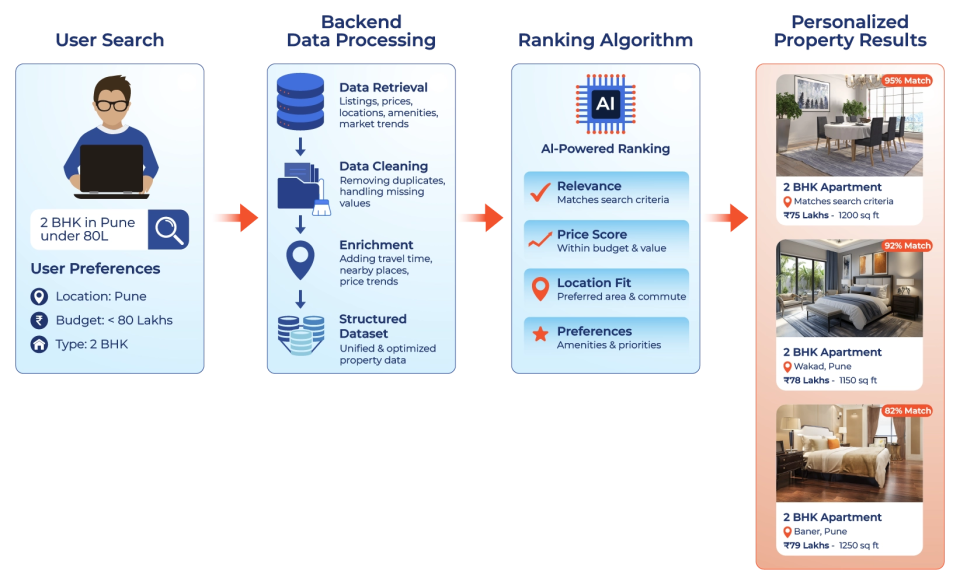
That simple search “2 BHK near Hinjewadi under 80L” is not just a query. It triggers a complex system where thousands of records are filtered, ranked, enriched, and presented in milliseconds.
This invisible layer is powered by structured property information and analytics.
From my experience working with large-scale pipelines, this field stands out because it combines human behavior, geography, economics, and technology. Unlike textbook datasets, this space is messy, inconsistent, and deeply tied to real-world dynamics, which is exactly what makes it so valuable.
Understanding Real Estate Data
At its core, this domain is about capturing the life cycle of properties. It reflects not only what a property is, but also how it evolves over time and how people interact with it.
Take an apartment in Pune as an example. Its value isn’t determined solely by size or number of rooms. Factors like nearby infrastructure, historical appreciation, rental demand, and even upcoming metro connectivity all influence its worth.
This makes the information inherently multi-dimensional, combining static attributes with dynamic signals such as market trends and behavioral patterns.
A simple way to think about it:
A property is a physical asset.
The surrounding information is its evolving digital footprint.
The Layers of Real Estate Data
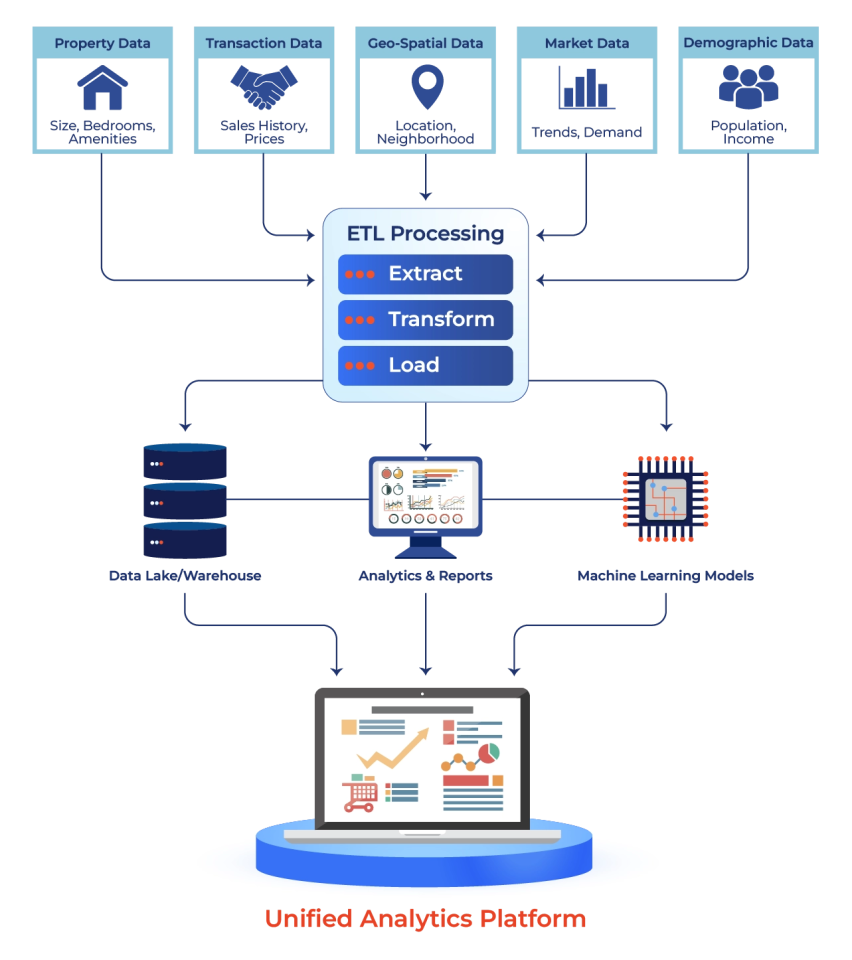
To truly understand this ecosystem, it helps to view it as interconnected layers rather than isolated elements. Each layer adds context and depth.
| Data Layer | What It Represents | Example |
|---|---|---|
| Property Data | Physical attributes of the property | 2 BHK, 1200 sq ft |
| Transaction Data | Historical buying/selling records | Sold for ₹75L in 2022 |
| Geo-Spatial Data | Location and surroundings | 2 km from metro |
| Market Data | Trends and demand-supply dynamics | Prices rising 8% YoY |
| Demographic Data | People and economic indicators | Avg income ₹12L/year |
When I worked on integrating multiple listing sources, I noticed how fragmented these layers were. One API would provide property details, another would supply location intelligence, and transaction records would arrive as batch files. The real challenge and opportunity was stitching them together into a unified view.
Why Real Estate Data Is More Important Than Ever Before
Traditionally, property decisions relied heavily on intuition and local knowledge. Today, that approach is rapidly being replaced by insight-driven strategies.
Buyers can now compare hundreds of options instantly. Investors can evaluate returns with far greater precision. And platforms have evolved into intelligent systems rather than simple listing portals.
These systems:
- Rank properties based on relevance
- Estimate pricing trends
- Identify anomalies
- Personalize recommendations
I once analyzed two nearly identical apartments with a 15% price difference. The reason wasn’t obvious until location enrichment revealed that one was closer to a planned metro line. That single factor explained the gap.
Real-World Applications of Real Estate Data
This domain becomes truly powerful when applied to practical problems.
For instance, price prediction models go far beyond historical values. When enriched with additional signals like infrastructure growth, crime rates, and school proximity, their accuracy improves significantly.
Rental yield analysis is another critical use case. By combining rental income with property pricing, investors can identify high-return opportunities without manual calculations.
Fraud detection is equally important. Duplicate listings, unrealistic pricing, and fake ownership claims are common challenges. Detecting these require a combination of clean pipelines, validation logic, and machine learning.
Exploring Real Estate Datasets
For anyone entering this space, datasets are the starting point.
Public sources provide foundational information, including land registries, census records, and mapping platforms. These are useful but often incomplete.
Curated platforms like Kaggle offer structured datasets that are ideal for experimentation and learning.
However, enterprise-grade insights typically rely on proprietary sources.
| Dataset Source | Accessibility | Use Case |
|---|---|---|
| Government Records | Free | Ownership, transactions |
| OpenStreetMap | Free | Geo-spatial mapping |
| Kaggle | Free | Practice & ML models |
| Private Providers | Paid | Enterprise analytics |
The trade-off is clear: accessibility versus completeness.
Dataset View
| Price | Location | Sqft | Amenities | Timestamp |
|---|---|---|---|---|
| ₹ 758,000 | Baner | 1250 sqft | Pool, Gym, Parking | 2024-04-18 08:25 |
| ₹ 754,000 | Wakad | 1190 sqft | Gym, Clubhouse, Parking | 2024-04-18 09:40 |
| ₹ 778,000 | Hinjewadi | 1200 sqft | Gym, Security, Parking | 2024-04-18 10:15 |
| ₹ 803,000 | Kharadi | 1200 sqft | Playground, Clubhouse, Parking | 2024-04-17 17:55 |
| ₹ 760,000 | Kharadi | 1255 sqft | Security, Parking | 2024-04-17 11:25 |
| ₹ 350,000 | Kothrud | 1100 sqft | Security, Parking | 2024-04-18 07:00 |
Key Real Estate Data Providers
At scale, specialized providers play a major role.
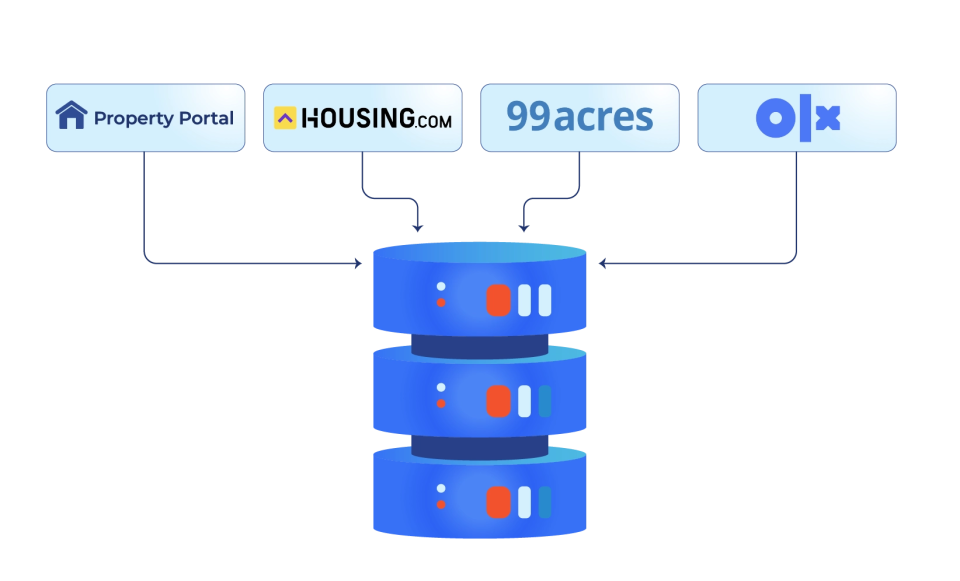
Globally, companies like Zillow and CoreLogic have built ecosystems around property intelligence. In India, platforms such as MagicBricks and 99acres dominate by aggregating listings and user interactions.
What’s interesting is that these platforms are no longer just marketplaces—they function as analytics engines.
They continuously collect user behavior, interaction patterns, and market signals, and turn them into insights that improve user experience and business results.
Challenges in Working with Real Estate Data
Working with property-related information is rarely straightforward.
Inconsistent formats are a constant issue. The same listing might appear as “2 BHK,” “2 Bedroom,” or “2BR” across platforms. Missing values are common, especially for amenities.
Duplication is another major challenge. In one project I handled, nearly 30% of listings were duplicates across sources. Resolving this required combining fuzzy matching, geo-coordinates, and pricing similarity.
Another critical issue is freshness. Prices change frequently, and outdated records can quickly lead to incorrect conclusions. This makes near-real-time processing increasingly important.
The Role of Data Engineering
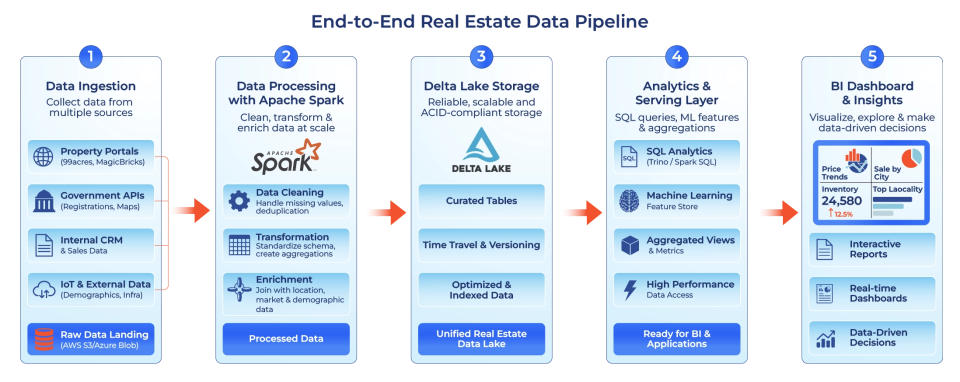
Behind every clean dashboard lies a well-designed pipeline.
Information is typically ingested from APIs, batch systems, or scraping mechanisms. It is then cleaned, normalized, enriched, and stored in scalable systems such as data lakes or warehouses.
From there, it powers analytics, dashboards, and machine learning models.
What makes this space so exciting is the mix of size, complexity, and real-world effect.
- High data volume
- Complex transformations
- Real-world impact
The Future of Real Estate Data
The future of this domain is deeply tied to technological advancements.
AI-driven valuation models are becoming more accurate. Smart city initiatives are generating richer signals. Satellite imagery and IoT are adding entirely new dimensions.
Soon, buying property may feel similar to analyzing a stock complete with forecasts, alerts, and interactive dashboards guiding decisions.
Conclusion
What was once an intuition-driven industry is now being reshaped by structured insights and analytics.
From making better decisions to powering predictive systems, this field keeps growing quickly. For engineers and analysts, it offers a uniquely challenging environment filled with imperfect inputs, complex transformations, and meaningful outcomes.
Real Estate Data – Frequently Asked Questions
Real estate data is simply information about properties, like their features, location, prices, and what’s happening in the market.
Examples include property size, price, transaction history, location coordinates, and rental values.
It helps buyers, sellers, and investors make informed decisions and enables predictive analytics.
Datasets are available from government portals, Kaggle, OpenStreetMap, and private providers.
Some datasets are free, but high-quality and detailed datasets are often paid.
It is used for price prediction, trend analysis, recommendation systems, and fraud detection.
Common challenges include duplication, missing values, inconsistent formats, and outdated information.
Tools like Spark, Databricks, SQL, Kafka, and cloud platforms are commonly used.
It refers to location-based data such as coordinates and proximity to important landmarks.
Yes, predictive models can estimate future prices using historical and market data.

Saurabh Tikekar | Data Engineer
Tired of broken scrapers and messy data?
Let us handle the complexity while you focus on insights.