

Every organization wrestle with exploding data volumes from retail transaction streams and financial audit trails to manufacturing IoT feeds, telecom call records, and pharmaceutical clinical datasets. Data retention establishes structured policies for how long information must be preserved, ensuring compliance while optimizing costs and risks. Poorly managed retention leads to regulatory fines exceeding $20M (GDPR violations), unnecessary storage bills, or critical evidence gaps during litigation.
This comprehensive guide, expanded with multi-industry examples, detailed regulations, case studies, frameworks, and 2026 trends, equips technical leaders, compliance officers, and data engineers. Informed by pipeline management across sectors like pharma research and enterprise analytics, it delivers actionable strategies.
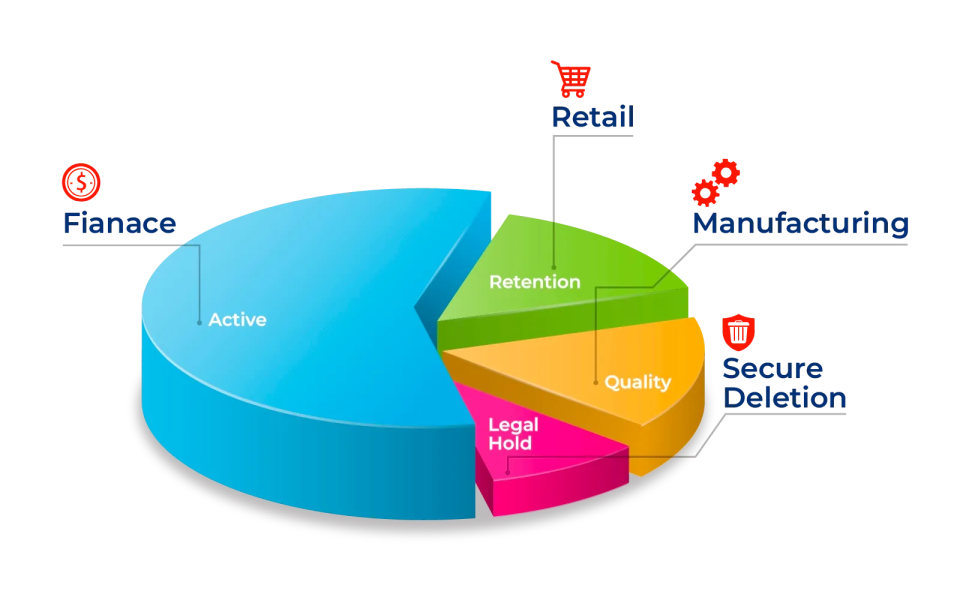
Data Retention Fundamentals
Retention policies dictate the duration and handling of data before archiving or deletion, balancing:
- Regulatory Mandates: SOX (7 years of financials), HIPAA (6+ years of health records
- Operational Value: Customer profiles for segmentation vs. ephemeral session logs
- Litigation Risks: Holds preserve data during legal proceedings.
- Economic Factors: Cold storage at $4/TB/mo vs. hot at $23/TB
Complete Lifecycle:
- Ingestion/Creation: Raw capture from sources
- Active Use: Frequent access (0-90 days)
- Warm Storage: Infrequent queries (90 days-3 years)
- Cold Archive: Compliance/rare access (3-15+ years)
- Disposition: Secure deletion or anonymization
Key Metrics:
- Over-retention Cost: Enterprises waste $1-5M/year
- Compliance Fines: GDPR averages €4.3M per violation
Detailed Industry Regulations
Financial Services (SOX, GLBA, SEC 17a-4, FINRA)
- Financial records/audit trails: 7 years
- Trade confirmations: 3-6 years
- Customer communications: 5 years
- Broker-dealer records: 6 years post-termination
Case: JPMorgan retains SEC-required emails for 7 years, tamper-proof in immutable storage.
Healthcare/Pharma (HIPAA, HITECH, FDA 21 CFR Part 11)
- PHI (Protected Health Information): 6 years from creation/last effective date 2
- Clinical trial data: 2 years post-approval or 15 years total
- Prescriptions/billing: 6-7 years
- Research records: Lifetime for pivotal trials
Pharma Example: Biodegradable polymer delivery studies retain raw HPLC/NMR spectra for 15 years for FDA audits.
Retail/E-commerce (PCI DSS, CCPA)
- Cardholder data: Delete post-authorization (90 days max)
- Transaction logs: 1 year PCI + 7 years tax
- Customer profiles: Until deletion request (CCPA “right to be forgotten”)
Case: Large e-commerce platforms typically purge PCI data within 90 days while retaining anonymized analytics for 3 years.
Manufacturing/Industrial (NERC, ISO 27001)
- Equipment telemetry: 5 years of predictive maintenance
- Quality assurance records: 7-10 years liability
- Safety incident logs: Lifetime
Telecommunications (CALEA, FCC)
- Call Detail Records (CDRs): 1-2 years of law enforcement access
- Location data: 6 months-2 years
Global Privacy (GDPR, LGPD, PIPEDA)
- Personal data: Strictly “necessary” duration + erasure rightsneumetric+1
- Pseudonymized analytics: Often indefinite
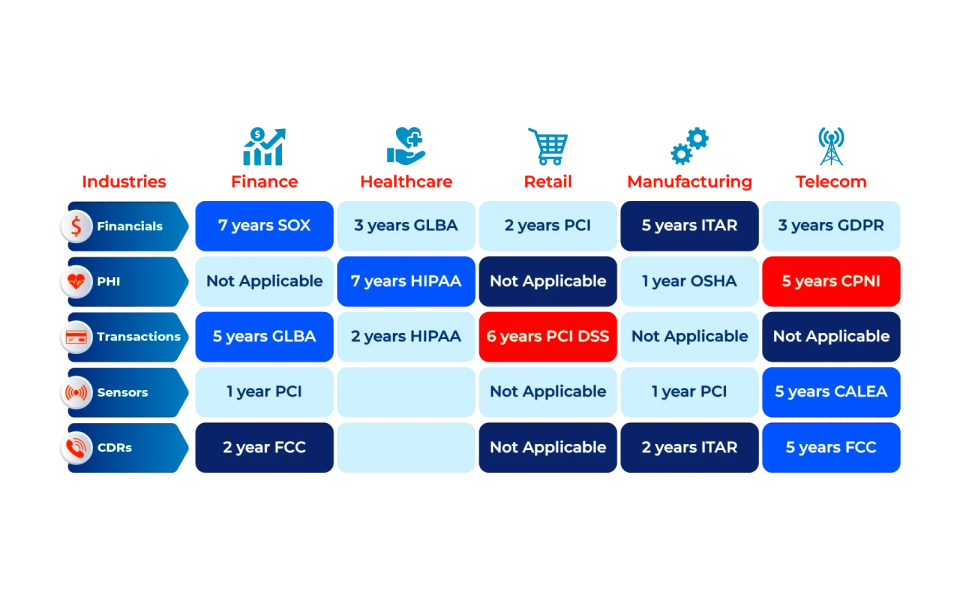
Now that we understand regulatory requirements, the next step is operationalizing retention through architecture and automation.
Advanced Retention Strategies
Strategy 1: Intelligent Classification & Tagging
Classify by sensitivity/value:
text
HIGH-RISK: PII, financials, PHI (7-15 years)
MEDIUM: Analytics aggregates (1-3 years)
LOW: Logs, caches (30-90 days)
Tools: AWS Macie, Azure Purview, Google DLP auto-scan + tag.
Strategy 2: Information Lifecycle Management (ILM)
Automated tiering:
# Airflow DAG example
def move_to_cold(ds, **kwargs):
if age > 365:
s3_client.copy_object(
CopySource=f”s3://hot/{obj}”,
Bucket=”cold-archive”,
Key=obj
)
Strategy 3: Multi-Tier Storage Economics
Expanded matrix with 2026 pricing:
| Tier | Frequency | Retention Fit | Cost/TB/mo | Providers | Use Case |
|---|---|---|---|---|---|
| Hot | Daily | 0-90 days | $23 | S3 Std, GCS | Real-time dashboards |
| Warm | Weekly/mo | 90d-3y | $12 | S3 IA, Azure Hot | BI reports |
| Cold | Quarterly | 3-7y | $6 | Glacier Flex | Compliance access |
| Deep Archive | Annual/audit | 7-15+y | $1-4 | Glacier VA, Iceberg | Legal holds |
ROI Case: Fortune 500 manufacturer tiered 50PB IoT data and saved $2.8M/year.
Strategy 4: Legal Hold & E-Discovery
Triggers: Lawsuits → automated freezes.
Tools: RelativityOne and Everlaw preserve in immutable WORM storage (Write Once Read Many).
Telecom Example: Verizon’s CALEA-compliant holds retain CDRs for 18 months for intercepts.

Step-by-Step Implementation Roadmap
Phase 1: Assessment (Weeks 1-4)
- Data census: Volume, types, locations
- Regulation mapping workshop
- Risk scoring: Fines vs. storage costs
Phase 2: Policy Development (Weeks 5-8)
- Tiered rules per class/industry
- Stakeholder approval (Legal, Compliance, IT)
- Pilot on 10% data volume
Phase 3: Technical Deployment (Months 2-3)
Multi-cloud example:
├── AWS: S3 Lifecycle + Macie classification
├── Azure: Purview + Storage lifecycle
└── GCP: DLP + BigQuery time partitioning
- Airflow/Scheduler integration
- Immutable storage for high-risk data
Phase 4: Operations & Monitoring (Ongoing)
- Quarterly compliance audits
- Cost dashboards (CloudHealth, Cloudability)
- Annual policy refresh for new regs (e.g., EU AI Act)
Quick Wins Code Snippet:
S3 Lifecycle policy
{
“Rules”: [{
“ID”: “PharmaTrialsToCold”,
“Filter”: {“Prefix”: “clinical-trials/”},
“Status”: “Enabled”,
“Transitions”: [{“Days”: 365, “StorageClass”: “GLACIER”}],
“Expiration”: {“Days”: 5475} // 15 years
}]}
Pitfalls, Costs & Case Studies
Top Pitfalls:
| Problem | Consequence | Mitigation |
|---|---|---|
| Uniform retention | $5M+ storage waste | Classification + tiering |
| Manual deletion | Human error fines | Automation + approvals |
| Ignoring holds | Evidence spoliation | Workflow integration |
| Regional oversights | Cross-border fines | Geo-specific policies |
Case Studies:
- Finance (SOX): Citi automated 7-year audit trails to Glacier, saving $1.2M.
- Healthcare: Mayo Clinic HIPAA-compliant PHI tiering reduced costs 45%.
- Retail (PCI): Walmart deletes card data in 30 days via DLP scanners.
- Manufacturing: Siemens NERC-compliant sensor data 5-year predictive ML value
Quantified Savings:
| Industry | Typical Waste | Post-Implementation |
|---|---|---|
| Finance | 45% storage | 25% reduction |
| Healthcare | 35% | 40% savings |
| Retail | 60% | 55% cut |
| Telecom | 50% | 65% optimized |
2026+ Emerging Trends
- AI/ML Classification: Auto-detect PHI/PII with 98% accuracy (Concentric AI)
- Zero-Trust Policies: Per-user retention granularity
- Quantum-Resistant Deletion: Post-quantum crypto wiping
- Sovereign Retention: The EU Data Act mandates local storage.
- Edge Retention: IoT devices with on-device expiry

Executive Checklist & Next Steps
Immediate Actions:
- Launch data inventory (1 week)
- Map top 3 regulations to datasets
- Calculate current over-retention costs
- Pilot tiering on non-critical data
| Category | Recommendations |
|---|---|
| Classification | Macie, Purview, DLP |
| Storage Mgmt | S3 Lifecycle, Azure ILM |
| Monitoring | CloudHealth, Datadog |
| Compliance | Varonis, Druva |
Proven Business Impact: Average 52% storage savings + bulletproof compliance.
Which regulation challenges you most: SOX audits, HIPAA PHI, or GDPR erasure? Drop your questions below!
FAQ: Data Retention Quick Reference
7 years for financial records and audits.
6 years from the date of creation.
Card data must be deleted after authorization.
Retain data only as long as necessary.
AWS S3 lifecycle policies.
Litigation notice triggers an automatic data freeze.
15 years total retention.
About 50% storage cost reduction.

Saurabh Tikekar | Data Engineer
Tired of broken scrapers and messy data?
Let us handle the complexity while you focus on insights.