

Introduction
In modern data systems, quality issues rarely appear in obvious ways. Usually, records pass schema checks, pipelines execute successfully, and dashboards populate without errors. Yet the final insights can still feel unreliable.
This usually happens because “valid” information is not always “accurate” information.
That distinction highlights the difference between data validation and data verification. Although the two terms are often treated as interchangeable, they solve different problems inside a data ecosystem.
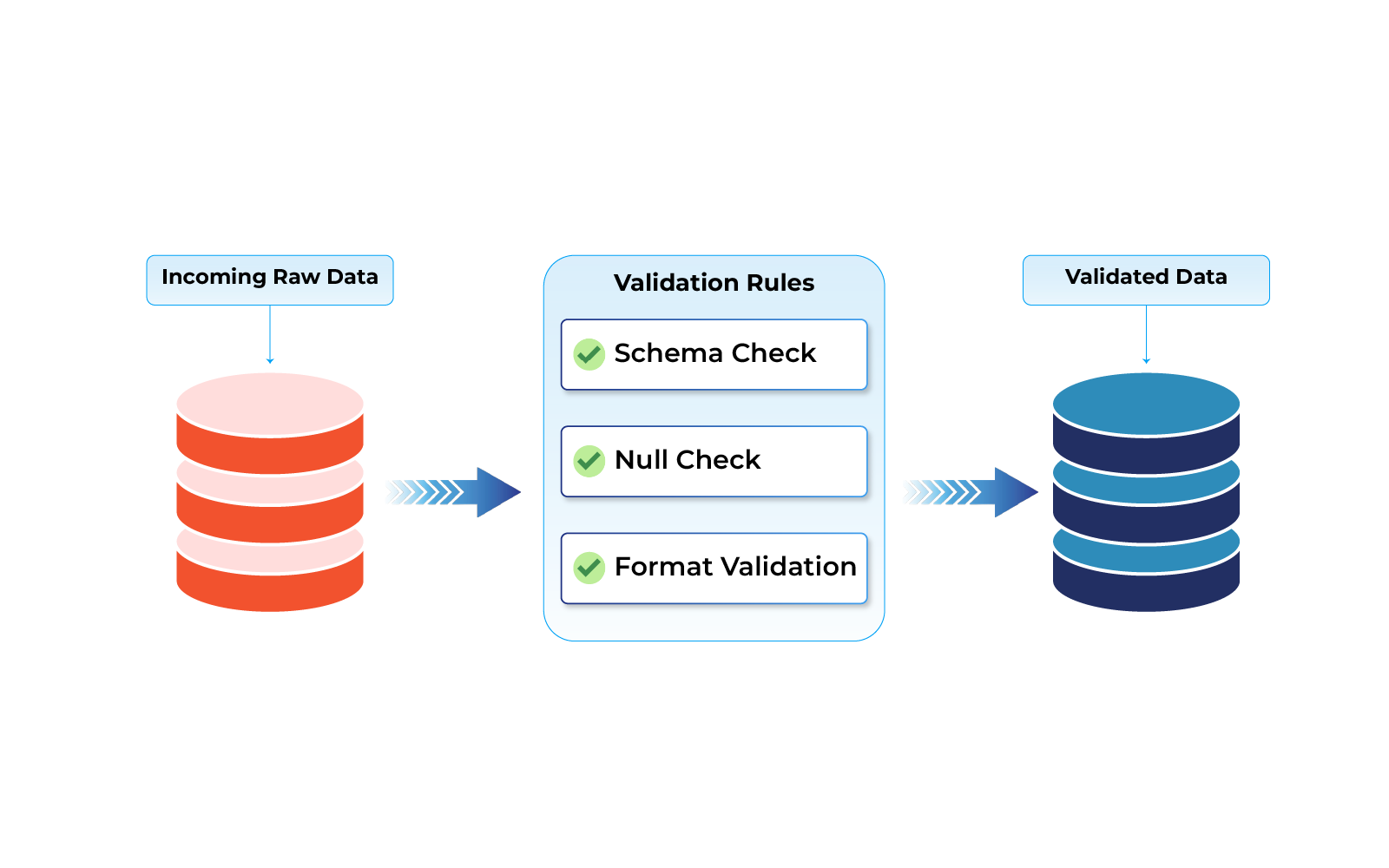
Validation focuses on whether incoming records follow predefined rules and formats. Verification focuses on whether those records actually represent trustworthy and accurate information.
Both are essential for building dependable systems, especially in large-scale data engineering environments.
Understanding the Fundamental Difference
At a broader level, both processes aim to improve data quality, but they operate from different perspectives.
Data validation checks whether information satisfies technical and business constraints before it moves further into a workflow.
Data verification examines whether the information itself can be trusted.
A simple comparison makes the distinction clearer:
- Validation asks: “Does this record follow the required rules?”
- Verification asks: “Does this record reflect reality correctly?”
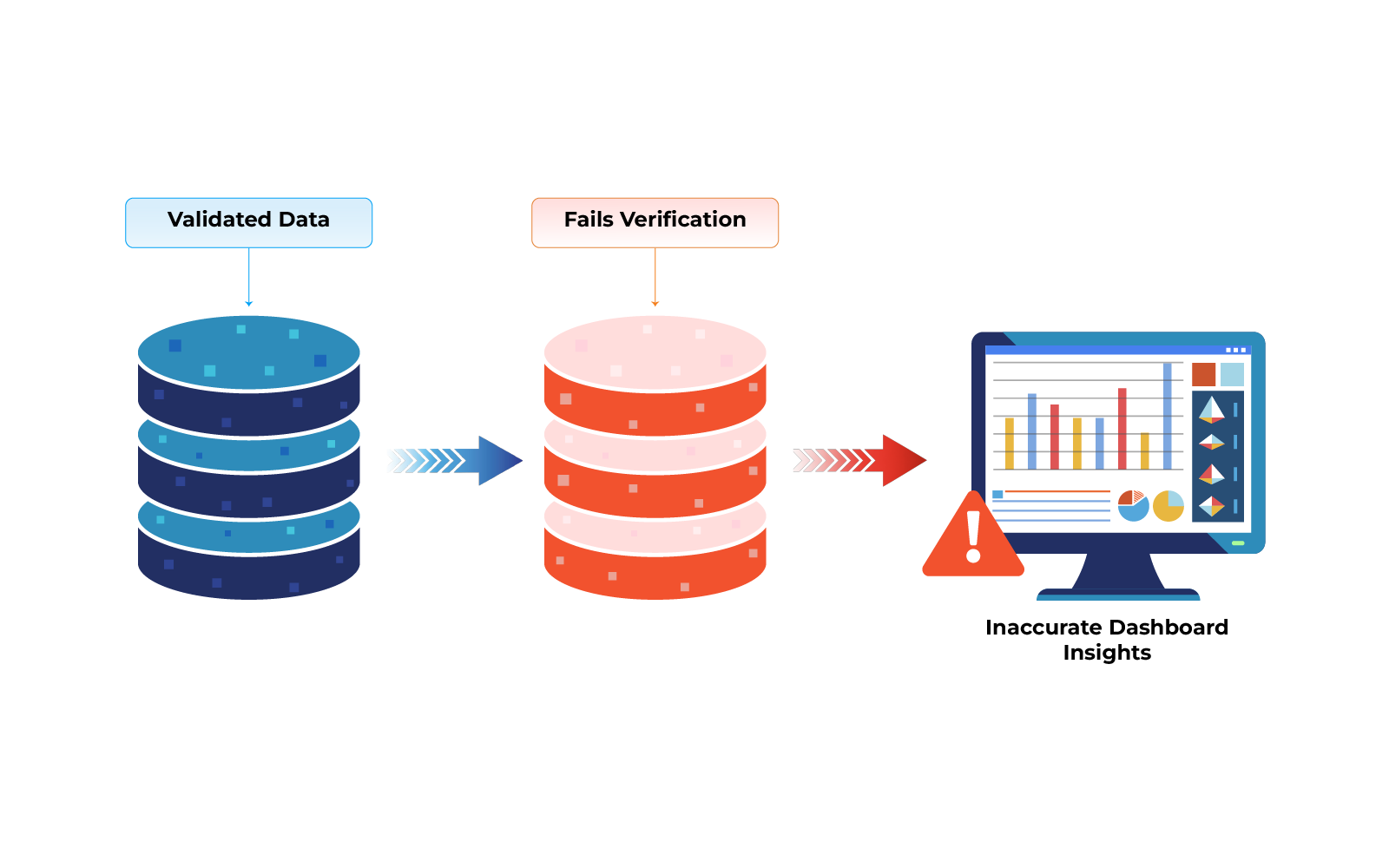
A dataset can satisfy validation rules while still containing misleading or inaccurate values.
What Is Data Validation?
Data validation acts as a protective layer during ingestion and processing stages. Its role is to ensure that records meet expected structural standards before entering downstream systems.
Typical validation checks include the following:
- Correct data types
- Mandatory field enforcement
- Range constraints
- Pattern and format checks
- Schema compliance
Consider a property listing platform where the price field must contain a numeric value.
Validation logic may ensure that:
- The field is not empty
- The value is numeric
- The value falls within acceptable system thresholds
If the record passes these checks, it is accepted into the pipeline.
However, structural correctness does not automatically guarantee accuracy.
For example, a property price of ₹5,000 may pass validation checks, but it could still be unrealistic for a premium location.
In this situation, the record is valid from a system perspective but questionable from a business perspective.
What Is Data Verification?
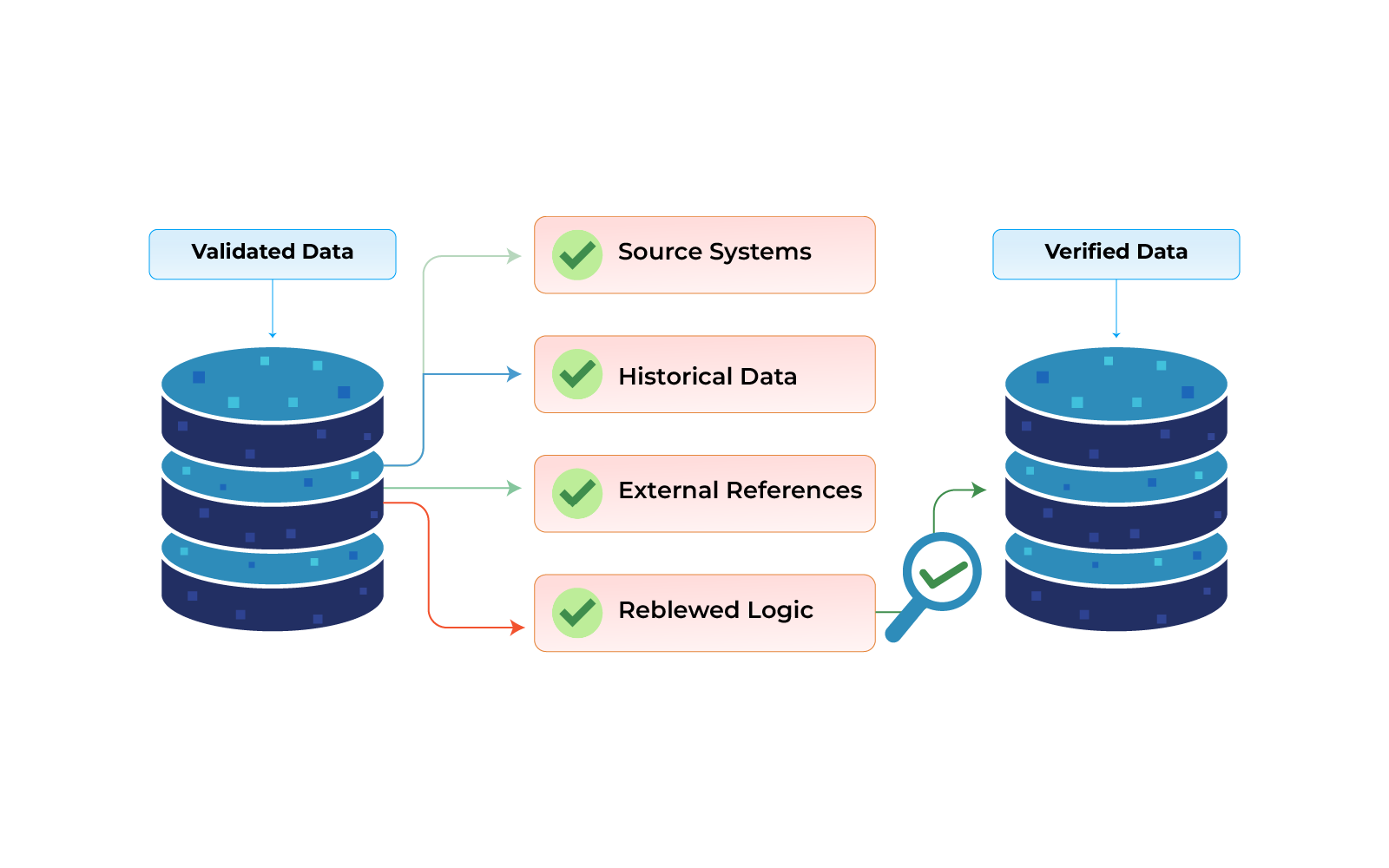
Data verification focuses on confirming whether information accurately represents the original source, expected business logic, or real-world conditions.
Unlike validation, verification is context-aware.
Using the same property listing example, verification might involve:
- Comparing values with historical pricing trends
- Matching records against trusted external systems
- Detecting anomalies using statistical models
- Checking consistency across multiple datasets
If a listing price is much lower than similar properties in the same area, verification processes can flag it for further review.
The key objective is trust.
While validation protects systems from malformed input, verification protects organizations from incorrect conclusions.
Comparing Validation and Verification
| Aspect | Data Validation | Data Verification |
|---|---|---|
| Primary Goal | Enforce rules and structure | Confirm reliability and accuracy |
| Focus Area | Format and constraints | Authenticity and correctness |
| Typical Timing | Before or during ingestion | During processing or analysis |
| Common Checks | Type validation, schema checks | Cross-referencing and anomaly detection |
| Main Outcome | Accept or reject records | Flag suspicious or inconsistent information |
The two processes address different layers of quality assurance and should not be viewed as replacements for one another.
Why the Difference Matters in Production Systems
In real-world pipelines, many organizations rely heavily on validation while giving minimal attention to verification.
This creates a hidden risk.
A dataset may pass every schema and constraint check while still containing inaccurate, duplicated, outdated, or misleading information.
For example:
- Duplicate transactions can distort reporting metrics.
- Incorrect timestamps may affect trend analysis.
- Mismatched customer IDs can break downstream joins.
- Unrealistic values can impact forecasting models.
These issues often remain invisible because technically the records are still considered “valid.”
This is especially important in industries such as:
- Finance
- Healthcare
- Real estate
- Insurance
- E-commerce
In such domains, even small inaccuracies can influence major operational or business decisions.
How Validation and Verification Complement Each Other
The strongest data quality strategies use both approaches together.
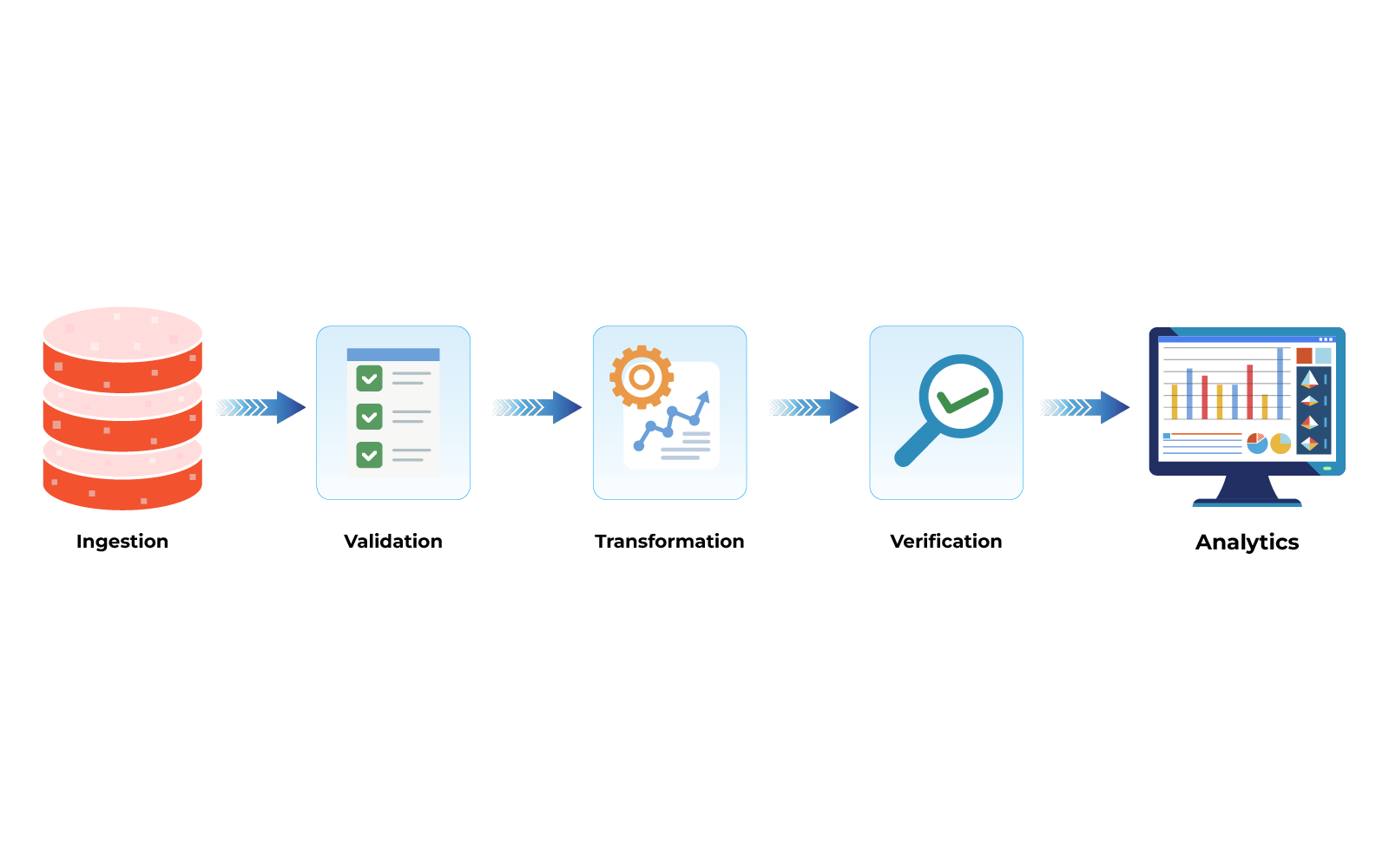
A practical workflow generally looks like this:
- Incoming records first pass through validation checks.
- Clean records move into processing layers.
- Verification logic evaluates consistency, reliability, and authenticity.
- Suspicious records are flagged for review or correction.
This layered model improves overall trust in analytics and reporting systems.
Validation eliminates malformed input early. Verification detects deeper quality problems that rule-based checks alone cannot identify.
Organizations that implement both layers typically reduce reporting inconsistencies and improve confidence in decision-making
Common Validation Techniques
Validation is usually deterministic and easier to automate.
Common approaches include:
- Schema enforcement
- SQL constraints
- Null checks
- Type enforcement
- Regex-based pattern validation
- Business rule evaluation
Many modern data quality frameworks provide built-in support for these checks.
Popular tools include:
- Great Expectations
- Apache Deequ
- DBT tests
- Pandera
These tools help engineers standardize quality enforcement across pipelines.
Common Verification Techniques
Verification is often more advanced because it depends heavily on business context.
Typical verification methods include the following:
- Cross-system comparisons
- Historical trend analysis
- Statistical anomaly detection
- Reference dataset matching
- Duplicate detection
- API-based confirmation checks
Unlike validation, verification may involve probabilistic logic instead of simple rule evaluation.
This makes implementation more computationally demanding but also significantly more valuable for maintaining trusted analytics.
Challenges in Implementation
Although both processes are important, implementing them effectively can be difficult.
Validation challenges usually involve:
- Managing evolving schemas
- Handling edge-case formats
- Maintaining rule consistency across systems
Verification introduces additional complexity because it requires the following:
- Reliable reference datasets
- Historical context
- Domain knowledge
- More processing resources
Another common challenge is balancing sensitivity.
If verification rules are too strict, systems generate excessive false positives. If rules are too relaxed, important inconsistencies remain undetected.
Designing practical verification logic often requires iterative tuning.
How Validation and Verification Work Together
Rather than choosing one over the other, the real goal is to use both as complementary layers.
Think of it as a pipeline:
- Incoming information is first validated to ensure it meets structural and business rules.
- Once accepted, it is then verified against trusted sources or logic to confirm accuracy.
This layered approach ensures that:
- Garbage input is blocked early
- Subtle inconsistencies are caught later
In one of my projects, adding a verification layer reduced reporting errors by nearly 20%, even though validation logic was already in place. That’s when it became clear validation alone is not enough.
Common Techniques Used
While approaches vary depending on the system, some common patterns emerge.
Validation often relies on schema enforcement, type checks, and rule-based constraints. Tools and frameworks typically support these out of the box.
Verification, however, tends to be more context-driven. It may involve:
- Cross-system comparisons
- Statistical checks
- Historical trend analysis
- External API validation
Because of this, verification logic is usually more complex and domain-specific.
The Role of Data Engineering
From a data engineering perspective, validation and verification influence architecture decisions directly.
Validation is usually implemented close to ingestion layers where records first enter the system.
Verification often appears later in the workflow, particularly in:
- Transformation pipelines
- Analytics layers
- Monitoring systems
- Reporting platforms
Modern data platforms increasingly treat quality monitoring as a core engineering responsibility rather than a secondary operational task.
As organizations become more data-driven, trustworthy information becomes just as important as scalable infrastructure.
The Future of Data Quality
The growing complexity of distributed systems has increased the importance of automated quality management.
Emerging trends include:
- AI-assisted anomaly detection
- Real-time observability platforms
- Automated lineage tracking
- Intelligent quality monitoring
Future verification systems may rely more on machine learning models that can identify subtle inconsistencies beyond static rule-based checks.
The objective is shifting from simply collecting clean records to maintaining continuously trusted information.
Conclusion
Although data validation and data verification are closely related, they solve different problems within a data ecosystem.
Validation ensures that records follow required formats, structures, and rules. Verification ensures that those records are believable, accurate, and reliable.
A robust data platform requires both.
Validation prevents malformed input from entering the system, while verification protects downstream analytics from misleading conclusions.
Understanding the distinction between these concepts is essential for building dependable pipelines, trustworthy dashboards, and high-quality decision-making systems.
Data Validation & Verification – Frequently Asked Questions
Data validation is the process of checking whether information follows predefined rules, formats, and constraints.
Data verification confirms whether information accurately represents trusted or original sources.
Validation focuses on structural correctness, while verification focuses on factual accuracy and trustworthiness.
Yes. A record may satisfy technical rules while still containing inaccurate or unrealistic values.
Validation is commonly applied during ingestion or preprocessing stages.
Verification is generally performed during processing, monitoring, or analytical evaluation.
Verification often depends on context, historical references, and external comparisons.
Common tools include Great Expectations, dbt tests, Apache Deequ, and Pandera.
For business-critical systems, verification is highly important because it improves trust and reliability.
Using both methods creates stronger quality assurance by combining structural checks with accuracy validation.

Saurabh Tikekar | Data Engineer
Tired of broken scrapers and messy data?
Let us handle the complexity while you focus on insights.