

In today’s data pipelines, whether Apache Spark ETL jobs, Snowflake ELT workflows, or multi-cloud lakehouses, the data catalogue serves as the essential guide holding operations together. It tracks lineage, schema changes, quality scores, and pipeline performance. Without proper catalogue management, pharmaceutical research pipelines falter: postdoc drug delivery assays become untraceable, regulatory audits fail, and high-impact publications slip away.
Drawing from years managing pipelines at MIT World Peace University, tracking polymer synthesis logs, clinical trial EDC feeds, and bioavailability models, this guide delivers 10 battle-tested practices. Expect pharmaceutical examples, practical analogies (catalogue as “pipeline GPS”), implementation roadmaps, and visual placeholders.
Why Catalogue Management Is Essential
Complex pipelines process terabytes from lab instruments (HPLC, NMR), EDC systems (REDCap), and bioreactor sensors. Poor tracking creates:
- Lineage Gaps: Cannot trace quality issues to the source
- Schema Drift: Silent column changes break ML models
- Compliance Risks: FDA/GDPR demand complete audit trails
- Debugging Delays: Hours tracing Spark failures across Airflow DAGs
One folate-conjugated polymer project lost a week to reconstructing assay lineages.
Proper practices cut MTTR by 70% and enable self-service analytics.
Best Practice 1: Implement Centralized Data Catalogues
Core Idea: Store all tracking information in one queryable system, not scattered Excel sheets.
Tools: Amundsen, DataHub, Marquez (Apache integration)
Schema: Lineage paths, tags, owners, quality metrics
Pharma Win: Tracked raw HPLC peaks through Spark scoring; auditors approved JSON exports.
Pro Tip: Airflow sensors auto-populate on DAG completion.
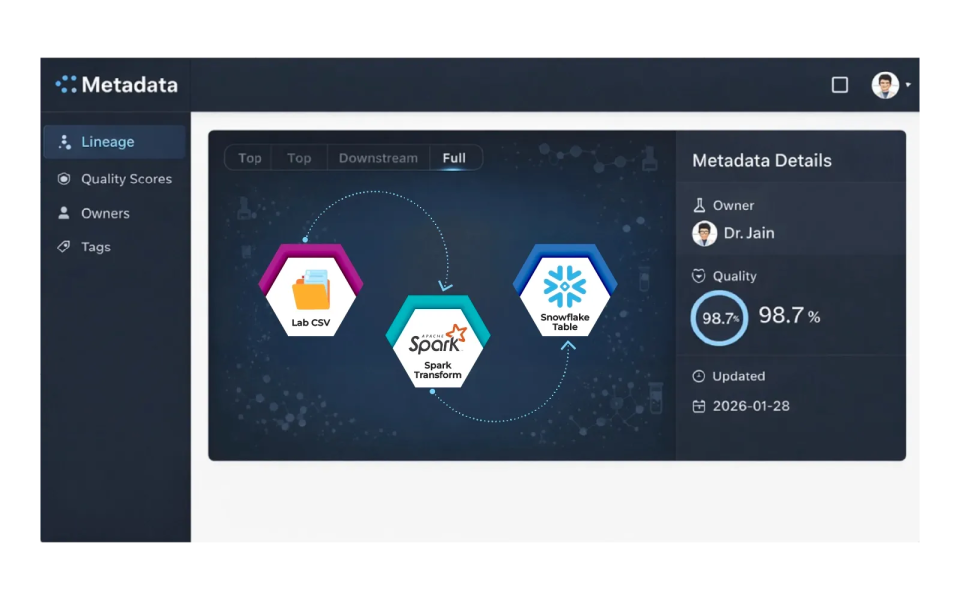
Best Practice 2: Automate Complete Lineage Tracking
Core Idea: Capture every transformation step automatically.
Implementation:
- Spark: SparkListener interfaces or spark-lineage libraries
- dbt: Native lineage via dbt ls –select
- Snowflake: QUERY_HISTORY + query tags
Real Example: A biodegradable polymer pipeline traced UDFs on molecular weight data, catching division-by-zero errors.
Analogy: Complete lineage = “black box recorder” for pipeline crashes.
Best Practice 3: Standardize Column Tagging & Business Glossary
Core Idea: Tag columns with clear business meaning.
Roadmap:
- Collibra/Atlan glossary: “bioavailability_score” = AUC/MRT ratio
- Auto-tagging via Great Expectations or Spark UDFs
- Query: SELECT * FROM tables WHERE tags LIKE ‘%pharma-trial%’
Pharma Impact: Unified “drug_release_profile” tags across 5 postdoc projects enabled cross-project analysis.
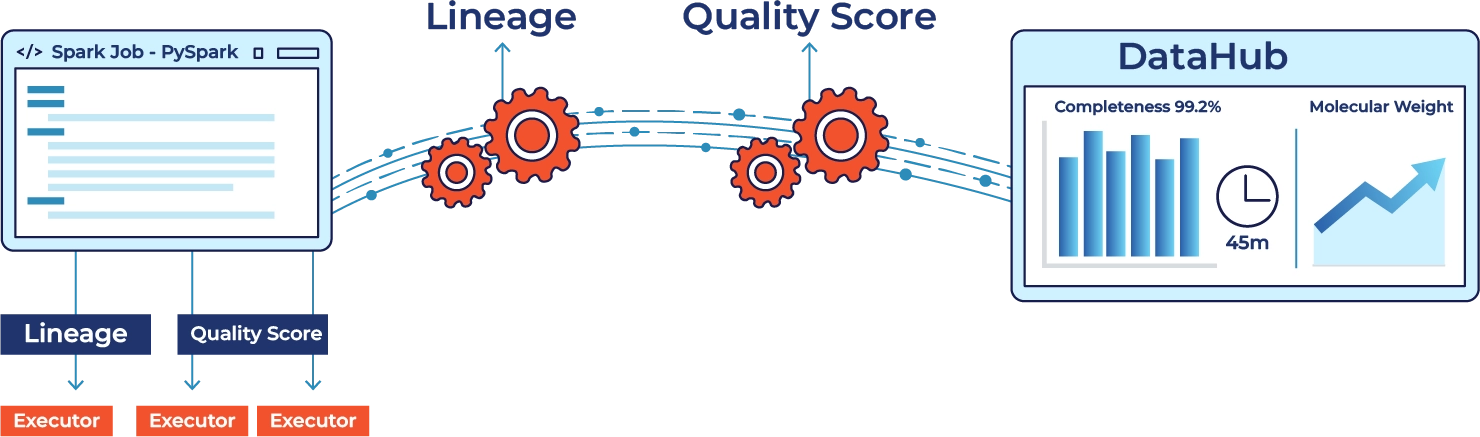
Best Practice 4: Real-Time Tracking Streams
Core Idea: Stream tracking data for live observability.
Stack:
- Kafka topics: lineage, quality, performance
- DataHub real-time indexing + Grafana alerts
Example: Live Spark executor metrics caught a bioreactor memory leak during 24/7 monitoring.
Best Practice 5: Schema Version Control
Core Idea: Treat schemas like code versions, review, and rollback.
Tools:
- dbt: schema.yml files in Git
- Spark: Delta Lake/Apache Iceberg enforcement
- Migration: Flyway/Liquibase for warehouse DDL
Anecdote: The postdoc added the “conjugation_efficiency” column mid-trial; Iceberg handled it seamlessly.
Best Practice 6: Quality Score Integration
Core Idea: Embed quality metrics as core tracking data.
Framework:
{ “completeness”: 98.7%,
“valid_molecular_weights”: “15,200/15,500”,
“freshness_lag”: “2h”}
Pharma Use: Great Expectations tests flagged failing assay batches for quarantine.
Metrics Dashboard Example:
| Pipeline | Completeness | Freshness | Last Tested |
|---|---|---|---|
| Polymer Synthesis | 99.2% | 45m | 2026-01-28 |
| Trial EDC | 97.8% | 1h 12m | 2026-01-28 |
Best Practice 7: Dataset Ownership Tracking
Core Idea: Every dataset lists the owner, SLA, and deprecation date.
Template:
dataset: polymer_assay_v2
Owner: dr.jain@mitwpu.edu
SLA: P95 < 5 min
deprecation: 2026-12-31
Enforcement: Airflow blocks the use of unowned datasets.
Best Practice 8: Cross-Platform Federation
Core Idea: Query tracking data across Snowflake, S3, and Postgres seamlessly.
Tools:
- Data Mesh: Amundsen federated search
- Trino/Presto catalog integration
- Pharma: Unified “patient_outcomes” search across EDC + lab data
Best Practice 9: Tracking-Driven Automation
Core Idea: Use catalogs to power pipelines automatically.
Examples:
- Auto-partitioning via Spark repartition
- Self-service: “Show pharma-team tables updated in the last 7 days”
- Alerting: quality_score < 95% → Slack notifications
Best Practice 10: Compliance Governance Framework
Core Idea: Make tracking data audit-ready infrastructure.
Framework:
- Policy: All pipelines emit structured tracking data
- Standards: JSON Schema validation
- 21 CFR Part 11 lineage reports
- Postdoc training programs
Regulatory Win: Passed IRB audit with complete spectra-to-statistics lineage.
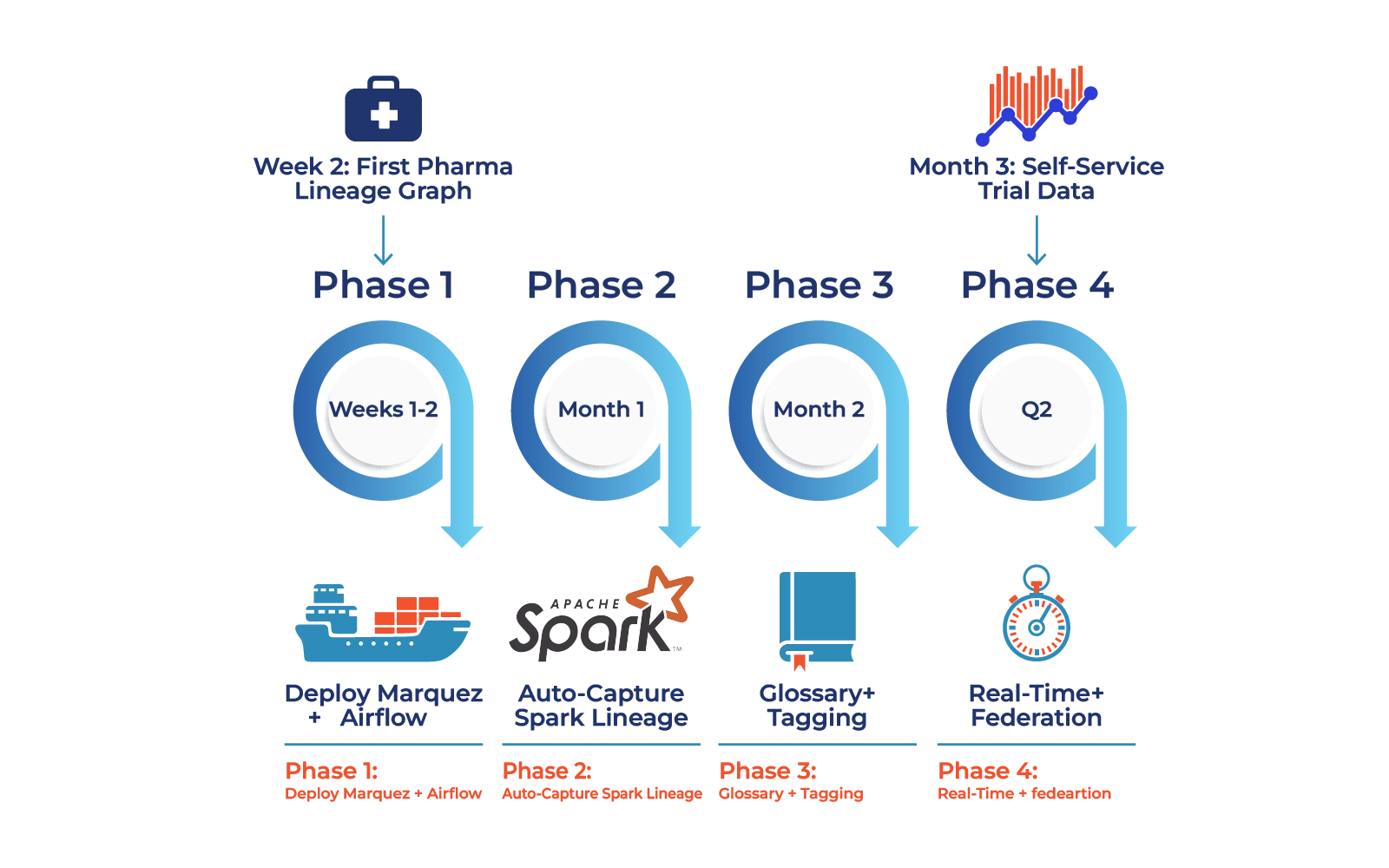
Implementation Roadmap
Phase 1 (Weeks 1-2): Marquez + Airflow integration
Phase 2 (Month 1): Automated Spark lineage capture
Phase 3 (Month 2): Business glossary + tagging
Phase 4 (Q2): Real-time streaming + federation
docker run -p 3000:3000 marquezproject/marquez
airflow DAGs trigger tracking_capture_dag
Proven Results
Teams report:
- 80% faster debugging
- 60% less compliance prep time
- 5x self-service adoption
- Zero production data mysteries
Drug delivery research shifted from reactive firefighting to strategic analysis across postdoc projects.
What’s your biggest pipeline tracking challenge? Share below.
FAQ: Managing Data Catalogues in Complex Pipelines
Lineage, schemas, quality scores, and data owners.
Marquez – Best for Spark lineage.
DataHub – Enterprise-grade metadata platform.
Amundsen – Powerful search & discovery focus.
spark-submit --conf spark.sql.queryExecutionListeners=marquez.listeners.SparkListener
Complete lineage enables 2-hour audits instead of weeks.
Iceberg or Delta Lake prevents silent column breaks.
Spark → Kafka → Live dashboard pipeline.
{"completeness": 99.2%, "freshness": "45m"}
By Week 2: 50% faster debugging.
Airflow blocks unowned datasets automatically.
Marquez + Great Expectations + dbt (Week 1 setup).

Saurabh Tikekar | Data Engineer
Tired of broken scrapers and messy data?
Let us handle the complexity while you focus on insights.